



Psilocybin is a naturally occurring
psychedelic compound found in many species of mushrooms. In this form it
has a long history of use by Man in the context of healing and
divination, and it is still employed in this manner today by indigenous
groups such as the Mazatec. Since the 1960’s awareness of psilocybin and
the fungi within which it resides has spread into the Western world.
Following the legal clamp down that resulted from widespread use of this
and other psychedelics like LSD and mescaline at this time, scientific
research into this compound and other psychedelics all but drew to a
halt. In the last few years regulatory red tape has been loosening to
some degree, and scientists have began studying psilocybin for a number
of reasons. It appears that psilocybin is a highly multifaceted compound
and has the capacity to act as a profound tool in the study of the
brain and consciousness, as well as act as a treatment for a variety of
psychological conditions.
Psilocybin is a compound of very low physical toxicity, but it can exert very powerful psychological effects, and the correct set and setting are of key importance when the drug is administered to reduce the chances of adverse reactions and to maximise potential benefits. On ingestion, psilocybin is dephosphorylated into the pharmacologically active molecule psilocin which closely resembles a key neurotransmitter serotonin in structure, and because of this it had a high affinity for 5-HT2A and 5-HT1 serotonin receptors where it mimics the effect of the neurotransmitter. The psychedelic effects of psilocybin can be prevented by the chemical ketanserin, which acts as a 5-HT2A receptor antagonist, blocking psilocybin’s access to the receptor sites and preventing it from exerting an effect (Vollenweider et al. 1999). These receptors are located at varying densities in many parts of the brain, and play important roles in mood and motivation regulation, among other things. At medium doses psilocybin has also been found to increase an increase in cerebral metabolic rate of glucose, particularly in the frontomedial and frontolateral cortex (24.3%), anterior cingulate (24.9%) and temporomedial cortex (25.3%) brain regions (Vollenweider et al. 1997).
Recent technological developments such as functional magnetic resonance imaging (fMRI) are allowing researchers to examine the brain with greater precision and less invasively than ever before. Brain imaging studies of healthy volunteers under psilocybin have found that brain activity was reduced in the default-mode network via a reduction in blood flow, and hub regions such as the thalamus and anterior and posterior cingulate cortex were affected, and this in turn has downstream effects on consciousness, leading to a more unconstrained, expansive and free flowing state when compared to cognition in a sober state (Carhart-Harris et al. 2012). An overactive default mode network is associated with depressive states and obsessive rumination, so a reduction in activity of this network may have important implications for the treatment of depression. A reduction of activity in the default-mode network is also linked to experiences of ego dissolution commonly associated with psilocybin. This network is linked to our personality and sense of self, with the latter being experienced as less solid under psilocybin, and there is a sense of novelty, with people commonly describing experiencing the world akin to new, as through child like eyes. Activity in the medial prefrontal cortex was consistently decreased by psilocybin, which is of interest as this area has been observed to be hyperactive in people experiencing major depressive episodes. Mindfulness meditation has also been found to reduce activity in these same brain regions.
More brain imaging research has also shown the psilocybin enhances autobiographical recollection and facilitates the recall of memories in a vivid fashion in healthy volunteers, and that there was a correlation between vividness of memories and subjective well being at a two week follow up after the session. Increased activity in brain regions that process visual and other sensory information was also observed. This aspect of psilocybin suggests it may be an aid to psychotherapy as a tool to facilitate the recall of salient memories or to aid in the reduction of fixation on negative memories, while also having the potential to enhance creative thinking (Carhart-Harris et al. 2012).
Further brain imaging research has built on this past research and
shown that psilocybin increases the amplitude of activity in brain
regions that are reliably activated during dream sleep and which form
part of the brains more ancient and primitive emotion system. At the
same time an expanded state of consciousness is facilitated, with
respect to an increased breadth of associations made by the brain under
the drug and the ease with which this occurs compared to sober states
(Tagliazucchi et al. 2014). This research indicates that
psilocybin may allow access to waking dream states, and so allow active
unconscious emotional processing and learning that is associated with
dreaming, while also being an aid in creative thinking and problem
solving, while having therapeutic applications for its ability to access
the primal parts of the brain. It appears the state of consciousness
resulting from psilocybin ingestion leads to disorganised and reduced
activity in the ego system which in turn permits disinhibited and
increased activity on the emotion system. This builds on evidence in
other studies with the compound that psilocybin may be a useful aid for
certain forms of psychotherapy.
Further analysis of the recent MRI findings of human brains under psilocybin has shown that the drug increases connection and communication between brain regions that are usually more disconnected in a sober state, and in an organised and stable fashion; the brain’s connectivity pattern is distinctly different under psilocybin. It is possible that experiences such as synaesthesia reported under psychedelics, where different sensory perceptions cross over and merge, may occur due to these alterations in brain connectivity. The function of the brain under psilocybin can be described as less constrained and more intercommunicative compared to a sober brain state (Petri et al. 2014).
More recent research has shown that psilocybin administration results in reduced amygdala reactivity, which in turn is correlated with positive mood in healthy volunteers (Kraehenmann et al. 2014). Thus, psilocybin may have potential as a treatment for anxiety and depression, with amygdala overactivity linked with negative mood states in patients with major depression. Research into psilocybin’s role as a treatment for depression and anxiety is ongoing. Current anti-depressant treatments only dampen symptoms, require chronic use to be effective, are only effective for a certain proportion of people, they tend to come with a range of side effects, and for some such as the commonly prescribed SSRI’s, withdrawals can be prolonged. Psilocybin could provide an alternative, more effective way of treating depression than is currently employed.
Research supported by MAPS and led by Francisco Moreno at the University of Arizona compromised the first FDA approval clinical pilot study of psilocybin in the US since 1970, and it was focussed on the treatment of obsessive-compulsive disorder (OCD). It was found that psilocybin administration resulted in a significant reduction in OCD symptoms in a number of patients (Moreno et al. 2006), and this is hypothesised to occur via a downregulation of serotonin receptors, resulting in a reduced responsiveness to serotonin (Halberstadt & Geyer 2011).
Psilocybin has been found to reduce the pain and symptoms of cluster headaches (Vollenweider & Kometer 2010; Sun-Edelstein & Mauskrop 2011) which are highly debilitating, are considered one of the most painful syndromes known to Man and are linked to a high suicide rate. No other treatments are known to stop cluster headache cycles and sub-psychedelic doses of psilocybin (and LSD) are effective. Psilocybin has been found to decrease blood flow in the hypothalamus, where blood flow increases during cluster headache episodes, which may partly explain its efficacy in treating this condition (Carhart-Harris et al. 2012). Further research in this area is certainly warranted.
Recent studies have used psilocybin in the treatment of alcoholism and tobacco addiction. A recently completed pilot study with 15 participants using medium and large doses of the drug yielded highly promising preliminary results, and further research is certainly warranted. 12 of 15 study participants (80%) showed abstinence at a six month follow up, while current treatments for tobacco addiction have a much lower success result, not exceeding 35% (Johnson et al. 2014). This was a small pilot study to test the feasibility of using psilocybin to treat tobacco addiction so it is important not to draw any definitive conclusions regarding the efficacy of psilocybin in treating tobacco addiction, but the results are certainly encouraging and supportive of further research.
Psychedelics like psilocybin act in a number of different ways in the brain to affect addictive syndromes. They act on the receptors in the brain associated with drug seeking behaviour, while reducing blood flow to areas of the brain associated with emotional processing and higher function that tend to be overactive in depressives. This can restrain negative circular thought patterns associated with addiction. The temporary chaotic state induced by psychedelics seems to weaken reinforced brain connections and dynamics and the experience provides a window of reflection where people can view their life and addiction issues from a wider perspective. People who were more successful in quitting smoking had higher ‘mystical experience’ scores, and in other studies, the psilocybin induced mystical experience was found to cause positive changes in measures of life satisfaction and well being, as well as long term personality change, particularly in openness.
Low doses of the compound, and chronic high doses have recently been found to increase hippocampal neurogenesis in mice, and increased the speed of their ‘unlearning’ of negative fear behaviour responses when compared to drug free controls, an effect that may hold promise in the treatment of post-traumatic stress disorder (PTSD) and related pathologies (Catlow et al. 2013). Thus psilocybin may have applications for treating PTSD in humans, a syndrome characterised by highly abnormal brain function, including impaired hippocampal function (Shin et al. 2006). Impaired hippocampal neurogenesis has also been implicated in cognitive disorders such as anxiety, depression, post-traumatic stress disorder (PTSD), addiction (Canales 2013) and neurodegenerative diseases. The psilocybin was also found to decrease activity in the medial frontal cortex regions of the mice, this area being linked to overactivity in sufferers of PTSD, and this has also been observed in human studies (Carhart-Harris et al. 2012). It may be that psilocybin, like ketamine, alters glutamatergic neurotransmission, this being linked with neurogenesis and neuroplasticity in the brain (Vollenweider & Kometer 2010).
Psilocybin is being studied for its efficacy at assisting terminally ill cancer patients by easing their psychological suffering implicated with their approaching death. Initial results, where low doses of the drug are employed, combined with supportive psychotherapy, show great promise in psilocybin assisting people by reducing anxiety and existential angst, reducing dependency on pain medication following the session and allowing people to make the most of their remaining time. Effects from a single psilocybin session can be long term, with effects lasting from two weeks up to six months and beyond (Vollenweider & Kometer 2010; Grob et al. 2011). Further research in this area is ongoing, and is being conducted by Dr Stephen Ross of New York University with support from the Heffter Research Institute.
Research with high doses of psilocybin have found it can induce long term, positive changes in personality and feelings of life satisfaction and well being (Griffiths et al. 2011). Openness is one of the five measures of personality, and can be significantly changed in the long term by a single dose of psilocybin, especially if people have a mystical experience during a session (Griffiths et al. 2011). This is of great interest, as after the age of 30 personality is thought to be generally fixed in the individual, and openness is thought to decline with age, hinting that psilocybin can influence neuroplasticity of the brain. This change in personality remained as strong 14 months after the session, and appears to be long term (Griffiths et al. 2011). Openness covers personality traits such as an appreciation for new experiences, broadness of imagination and finding value in aesthetics, emotion, curiosity and creativity, with an increased hunger for knowledge (MacLean et al. 2011).
Psilocybin may have application in psychical research. In 1997 there was some research into how psilocybin could influence results from remote viewing conducted by students at the University of Amsterdam. In the experiment, test-subjects under the influence of cannabis selected the right target only slightly above chance expectancy. Test-subjects under the influence of psilocybin selected the target with a success rate of 58.3%, which is a statistically significant result. The experiment was small however with only 12 subjects, but further research with larger sample sizes is warranted (Millay 1999).
This is an exciting time for psilocybin research. The last few years has seen an explosion in research, and this itself indicates that the strongly anti psychedelic mind-set in scientific circles, a hangover from the 1960’s, is beginning to dissipate, and researchers now have cutting edge technologies such as fMRI to aid them in the work and increase the precision and breadth of their findings. Research in many areas is ongoing, and new avenues for enquiry are opening up. David Nutt and his team at Imperial College are conducting a study on the efficacy of psilocybin as a treatment for depression, building on their previous work there. Just months ago a pilot study was completed in the US, based at John Hopkins University, looking at the effects of psilocybin on behaviour, psychology and brain function in long-term meditators. Psilocybin has a long history of use by Man, and has been revered as a powerful medicine and ally for a very long time. Modern science is confirming and building on ancient wisdom to allow us to better understand this amazing and highly multifaceted molecule, in order that we can better utilise its tremendous capacity to heal people.
Notes
Canales, J.J. (2013) Deficient plasticity in the hippocampus and the spiral of addiction: focus on adult neurogenesis. Current Topics in Behavioural Neuroscience, 15, 293-312.
Catlow, B.J., Song, S., Paredes, D.A., Kirstein, C.L. & Sanchez-Ramos, J. (2013) Effects of psilocybin on hippocampal neurogenesis and extinction of trace fear conditioning. Experimental Brain Research, 228, (4), 481-491.
Carhart-Harris, R.L., Erritzoe, D., Williams, T. Stone, J.M., Reed, L.J., Colasanti, A., Tyacke, R.J., Leech, R., Malizia, A.L., Murphy, K., Hobden, P., Evans, J., Fielding, A., Wise, R.G. & Nutt, D.J. (2012) Neural correlates of the psychedelic state as determined by fMRI studies with psilocybin. Proceedings of the National Academy of Sciences of the United States of America, 109, 2138-2143.
Carhart-Harris, R.L., Leech, R., Williams, T.M., Erritzoe, D., Abbasi, N., Bargiotas, T., Hobden, P., Sharp, D.J., Evans, J., Feilding, A., Wise, R.G. & Nutt, D.J. (2012) Implications for psychedelic-assisted psychotherapy: functional magnetic resonance imaging study with psilocybin. The British Journal of Psychiatry, 200, (3), 238-244.
Griffiths, R.R., Johnson, M.W., Richards, W.A., McCann, U. & Jesse, R. (2011) Psilocybin occasioned mystical-type experiences: Immediate and persisting dose-related effects. Psychopharmacology (Berl), 218, 649-665.
Grob, C.S., Danforth, A.L., Chopra, G.S., Hagerty, M., McKay, C.R., Halberstadt, A.L. & Greer, G.R. (2011) Pilot study of psilocybin treatment for anxiety in patients with advanced-stage cancer. Archives of General Psychiatry, 68, (1), 71-78.
Halberstadt, A.L. & Geyer, M.A. (2011). Multiple receptors contribute to the behavioural effects of indoleamine hallucinogens. Neuropharmacology, 61, (3), 364–81.
Johnson, M.W., Garcia-Romeu, A., Cosimano, M.P. & Griffiths, R.R. (2014) Pilot study of the 5-HT2AR agonist psilocybin in the treatment of tobacco addiction. Journal of Psychopharmacology. In Press.
Millay, J. (1999) Multidimensional Mind: Remote Viewing in Hyperspace. North Atlantic Books, Berkeley, California, USA.
Kellner M. (2010). Drug treatment of obsessive-compulsive disorder. Dialogues in Clinical Neuroscience, 12, (2), 187–97.
Kraehenmann, R., Preller, K.H., Scheidegger, M. Pokorny, T., Bosch, O.G., Seifritz, E. & Vollenweider, F. X. (2014) Psilocybin-Induced Decrease in Amygdala Reactivity Correlates with Enhanced Positive Mood in Healthy Volunteers. Biological Psychiatry. In Press.
MacLean, K.A., Johnson, M.W. & Griffiths, R.R. (2011) Mystical experiences occasioned by the hallucinogen psilocybin lead to increases in the personality domain of openness. Journal of Psychopharmacology, 25, (11), 1453-1461.
Moreno, F.A., Wiegand, C.B., Taitano, K. & Delgado, P.L. (2006) Safety, Tolerability, and Efficacy of Psilocybin in 9 Patients With Obsessive-Compulsive Disorder. The Journal of Clinical Psychiatry, 67, 1735-1740.
Petri, G., Expert, P., Terkheimer, F., Carhart-Harris, R., Nutt, D., Hellyer, P.J. & Vaccarino, F. (2014) Homological scaffolds of brain functional networks. Journal of the Royal Society Interface, 11, (101), e20140873.
Shin, L.M., Rauch, S.L. & Pitman, R. K. (2006) Amygdala, Medial Prefrontal Cortex, and Hippocampal Function in PTSD. Annals of the New York Academy of Sciences, 1071, 67-79.
Sun-Edelstein C, Mauskop A. (2011). “Alternative headache treatments: nutraceuticals, behavioral and physical treatments”. Headache: the Journal of Head and Face Pain, 51, (3), 469–83.
Tagliazucchi, E., Carhart-Harris, R., Leech, R., Nutt, D. & Chialvo, D.R. (2014) Enhanced repertoire of brain dynamical states during the psychedelic experience. Human Brain Mapping. In Press.
Vollenweider, F.X. & Kometer, M. (2010) The neurobiology of psychedelic drugs: implications for the treatment of mood disorders. Nature Reviews Neuroscience, 11, (9), 642–51.
Vollenweider, F.X., Leenders, K.L., Scharfetter, C., Maguire, P., Stadelmann, O. & Angst, J. (1997) Positron Emission Tomography and Fluorodeoxyglucose Studies of Metabolic Hyperfrontality and Psychopathology in the Psilocybin Model of Psychosis. Neuropsychopharmacology, 16, (5), 357-372.
Vollenweider, F.X., Vontobel, P., Hell, D. & Leenders, K.L. 5-HT Modulation of Dopamine Release in Basal Ganglia in Psilocybin-Induced Psychosis in Man-A PET Study with [11C]raclopride. Neuropsychopharmacology, 20, (5), 424-433.
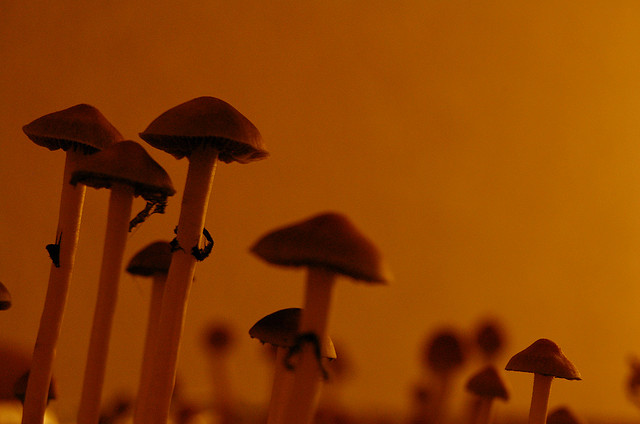
Image by afgooey74, courtesy of Creative Commons license.
Psilocybin is a compound of very low physical toxicity, but it can exert very powerful psychological effects, and the correct set and setting are of key importance when the drug is administered to reduce the chances of adverse reactions and to maximise potential benefits. On ingestion, psilocybin is dephosphorylated into the pharmacologically active molecule psilocin which closely resembles a key neurotransmitter serotonin in structure, and because of this it had a high affinity for 5-HT2A and 5-HT1 serotonin receptors where it mimics the effect of the neurotransmitter. The psychedelic effects of psilocybin can be prevented by the chemical ketanserin, which acts as a 5-HT2A receptor antagonist, blocking psilocybin’s access to the receptor sites and preventing it from exerting an effect (Vollenweider et al. 1999). These receptors are located at varying densities in many parts of the brain, and play important roles in mood and motivation regulation, among other things. At medium doses psilocybin has also been found to increase an increase in cerebral metabolic rate of glucose, particularly in the frontomedial and frontolateral cortex (24.3%), anterior cingulate (24.9%) and temporomedial cortex (25.3%) brain regions (Vollenweider et al. 1997).
Recent technological developments such as functional magnetic resonance imaging (fMRI) are allowing researchers to examine the brain with greater precision and less invasively than ever before. Brain imaging studies of healthy volunteers under psilocybin have found that brain activity was reduced in the default-mode network via a reduction in blood flow, and hub regions such as the thalamus and anterior and posterior cingulate cortex were affected, and this in turn has downstream effects on consciousness, leading to a more unconstrained, expansive and free flowing state when compared to cognition in a sober state (Carhart-Harris et al. 2012). An overactive default mode network is associated with depressive states and obsessive rumination, so a reduction in activity of this network may have important implications for the treatment of depression. A reduction of activity in the default-mode network is also linked to experiences of ego dissolution commonly associated with psilocybin. This network is linked to our personality and sense of self, with the latter being experienced as less solid under psilocybin, and there is a sense of novelty, with people commonly describing experiencing the world akin to new, as through child like eyes. Activity in the medial prefrontal cortex was consistently decreased by psilocybin, which is of interest as this area has been observed to be hyperactive in people experiencing major depressive episodes. Mindfulness meditation has also been found to reduce activity in these same brain regions.
More brain imaging research has also shown the psilocybin enhances autobiographical recollection and facilitates the recall of memories in a vivid fashion in healthy volunteers, and that there was a correlation between vividness of memories and subjective well being at a two week follow up after the session. Increased activity in brain regions that process visual and other sensory information was also observed. This aspect of psilocybin suggests it may be an aid to psychotherapy as a tool to facilitate the recall of salient memories or to aid in the reduction of fixation on negative memories, while also having the potential to enhance creative thinking (Carhart-Harris et al. 2012).
Further analysis of the recent MRI findings of human brains under psilocybin has shown that the drug increases connection and communication between brain regions that are usually more disconnected in a sober state, and in an organised and stable fashion; the brain’s connectivity pattern is distinctly different under psilocybin. It is possible that experiences such as synaesthesia reported under psychedelics, where different sensory perceptions cross over and merge, may occur due to these alterations in brain connectivity. The function of the brain under psilocybin can be described as less constrained and more intercommunicative compared to a sober brain state (Petri et al. 2014).
More recent research has shown that psilocybin administration results in reduced amygdala reactivity, which in turn is correlated with positive mood in healthy volunteers (Kraehenmann et al. 2014). Thus, psilocybin may have potential as a treatment for anxiety and depression, with amygdala overactivity linked with negative mood states in patients with major depression. Research into psilocybin’s role as a treatment for depression and anxiety is ongoing. Current anti-depressant treatments only dampen symptoms, require chronic use to be effective, are only effective for a certain proportion of people, they tend to come with a range of side effects, and for some such as the commonly prescribed SSRI’s, withdrawals can be prolonged. Psilocybin could provide an alternative, more effective way of treating depression than is currently employed.
Research supported by MAPS and led by Francisco Moreno at the University of Arizona compromised the first FDA approval clinical pilot study of psilocybin in the US since 1970, and it was focussed on the treatment of obsessive-compulsive disorder (OCD). It was found that psilocybin administration resulted in a significant reduction in OCD symptoms in a number of patients (Moreno et al. 2006), and this is hypothesised to occur via a downregulation of serotonin receptors, resulting in a reduced responsiveness to serotonin (Halberstadt & Geyer 2011).
Psilocybin has been found to reduce the pain and symptoms of cluster headaches (Vollenweider & Kometer 2010; Sun-Edelstein & Mauskrop 2011) which are highly debilitating, are considered one of the most painful syndromes known to Man and are linked to a high suicide rate. No other treatments are known to stop cluster headache cycles and sub-psychedelic doses of psilocybin (and LSD) are effective. Psilocybin has been found to decrease blood flow in the hypothalamus, where blood flow increases during cluster headache episodes, which may partly explain its efficacy in treating this condition (Carhart-Harris et al. 2012). Further research in this area is certainly warranted.
Recent studies have used psilocybin in the treatment of alcoholism and tobacco addiction. A recently completed pilot study with 15 participants using medium and large doses of the drug yielded highly promising preliminary results, and further research is certainly warranted. 12 of 15 study participants (80%) showed abstinence at a six month follow up, while current treatments for tobacco addiction have a much lower success result, not exceeding 35% (Johnson et al. 2014). This was a small pilot study to test the feasibility of using psilocybin to treat tobacco addiction so it is important not to draw any definitive conclusions regarding the efficacy of psilocybin in treating tobacco addiction, but the results are certainly encouraging and supportive of further research.
Psychedelics like psilocybin act in a number of different ways in the brain to affect addictive syndromes. They act on the receptors in the brain associated with drug seeking behaviour, while reducing blood flow to areas of the brain associated with emotional processing and higher function that tend to be overactive in depressives. This can restrain negative circular thought patterns associated with addiction. The temporary chaotic state induced by psychedelics seems to weaken reinforced brain connections and dynamics and the experience provides a window of reflection where people can view their life and addiction issues from a wider perspective. People who were more successful in quitting smoking had higher ‘mystical experience’ scores, and in other studies, the psilocybin induced mystical experience was found to cause positive changes in measures of life satisfaction and well being, as well as long term personality change, particularly in openness.
Low doses of the compound, and chronic high doses have recently been found to increase hippocampal neurogenesis in mice, and increased the speed of their ‘unlearning’ of negative fear behaviour responses when compared to drug free controls, an effect that may hold promise in the treatment of post-traumatic stress disorder (PTSD) and related pathologies (Catlow et al. 2013). Thus psilocybin may have applications for treating PTSD in humans, a syndrome characterised by highly abnormal brain function, including impaired hippocampal function (Shin et al. 2006). Impaired hippocampal neurogenesis has also been implicated in cognitive disorders such as anxiety, depression, post-traumatic stress disorder (PTSD), addiction (Canales 2013) and neurodegenerative diseases. The psilocybin was also found to decrease activity in the medial frontal cortex regions of the mice, this area being linked to overactivity in sufferers of PTSD, and this has also been observed in human studies (Carhart-Harris et al. 2012). It may be that psilocybin, like ketamine, alters glutamatergic neurotransmission, this being linked with neurogenesis and neuroplasticity in the brain (Vollenweider & Kometer 2010).
Psilocybin is being studied for its efficacy at assisting terminally ill cancer patients by easing their psychological suffering implicated with their approaching death. Initial results, where low doses of the drug are employed, combined with supportive psychotherapy, show great promise in psilocybin assisting people by reducing anxiety and existential angst, reducing dependency on pain medication following the session and allowing people to make the most of their remaining time. Effects from a single psilocybin session can be long term, with effects lasting from two weeks up to six months and beyond (Vollenweider & Kometer 2010; Grob et al. 2011). Further research in this area is ongoing, and is being conducted by Dr Stephen Ross of New York University with support from the Heffter Research Institute.
Research with high doses of psilocybin have found it can induce long term, positive changes in personality and feelings of life satisfaction and well being (Griffiths et al. 2011). Openness is one of the five measures of personality, and can be significantly changed in the long term by a single dose of psilocybin, especially if people have a mystical experience during a session (Griffiths et al. 2011). This is of great interest, as after the age of 30 personality is thought to be generally fixed in the individual, and openness is thought to decline with age, hinting that psilocybin can influence neuroplasticity of the brain. This change in personality remained as strong 14 months after the session, and appears to be long term (Griffiths et al. 2011). Openness covers personality traits such as an appreciation for new experiences, broadness of imagination and finding value in aesthetics, emotion, curiosity and creativity, with an increased hunger for knowledge (MacLean et al. 2011).
Psilocybin may have application in psychical research. In 1997 there was some research into how psilocybin could influence results from remote viewing conducted by students at the University of Amsterdam. In the experiment, test-subjects under the influence of cannabis selected the right target only slightly above chance expectancy. Test-subjects under the influence of psilocybin selected the target with a success rate of 58.3%, which is a statistically significant result. The experiment was small however with only 12 subjects, but further research with larger sample sizes is warranted (Millay 1999).
This is an exciting time for psilocybin research. The last few years has seen an explosion in research, and this itself indicates that the strongly anti psychedelic mind-set in scientific circles, a hangover from the 1960’s, is beginning to dissipate, and researchers now have cutting edge technologies such as fMRI to aid them in the work and increase the precision and breadth of their findings. Research in many areas is ongoing, and new avenues for enquiry are opening up. David Nutt and his team at Imperial College are conducting a study on the efficacy of psilocybin as a treatment for depression, building on their previous work there. Just months ago a pilot study was completed in the US, based at John Hopkins University, looking at the effects of psilocybin on behaviour, psychology and brain function in long-term meditators. Psilocybin has a long history of use by Man, and has been revered as a powerful medicine and ally for a very long time. Modern science is confirming and building on ancient wisdom to allow us to better understand this amazing and highly multifaceted molecule, in order that we can better utilise its tremendous capacity to heal people.
Notes
Canales, J.J. (2013) Deficient plasticity in the hippocampus and the spiral of addiction: focus on adult neurogenesis. Current Topics in Behavioural Neuroscience, 15, 293-312.
Catlow, B.J., Song, S., Paredes, D.A., Kirstein, C.L. & Sanchez-Ramos, J. (2013) Effects of psilocybin on hippocampal neurogenesis and extinction of trace fear conditioning. Experimental Brain Research, 228, (4), 481-491.
Carhart-Harris, R.L., Erritzoe, D., Williams, T. Stone, J.M., Reed, L.J., Colasanti, A., Tyacke, R.J., Leech, R., Malizia, A.L., Murphy, K., Hobden, P., Evans, J., Fielding, A., Wise, R.G. & Nutt, D.J. (2012) Neural correlates of the psychedelic state as determined by fMRI studies with psilocybin. Proceedings of the National Academy of Sciences of the United States of America, 109, 2138-2143.
Carhart-Harris, R.L., Leech, R., Williams, T.M., Erritzoe, D., Abbasi, N., Bargiotas, T., Hobden, P., Sharp, D.J., Evans, J., Feilding, A., Wise, R.G. & Nutt, D.J. (2012) Implications for psychedelic-assisted psychotherapy: functional magnetic resonance imaging study with psilocybin. The British Journal of Psychiatry, 200, (3), 238-244.
Griffiths, R.R., Johnson, M.W., Richards, W.A., McCann, U. & Jesse, R. (2011) Psilocybin occasioned mystical-type experiences: Immediate and persisting dose-related effects. Psychopharmacology (Berl), 218, 649-665.
Grob, C.S., Danforth, A.L., Chopra, G.S., Hagerty, M., McKay, C.R., Halberstadt, A.L. & Greer, G.R. (2011) Pilot study of psilocybin treatment for anxiety in patients with advanced-stage cancer. Archives of General Psychiatry, 68, (1), 71-78.
Halberstadt, A.L. & Geyer, M.A. (2011). Multiple receptors contribute to the behavioural effects of indoleamine hallucinogens. Neuropharmacology, 61, (3), 364–81.
Johnson, M.W., Garcia-Romeu, A., Cosimano, M.P. & Griffiths, R.R. (2014) Pilot study of the 5-HT2AR agonist psilocybin in the treatment of tobacco addiction. Journal of Psychopharmacology. In Press.
Millay, J. (1999) Multidimensional Mind: Remote Viewing in Hyperspace. North Atlantic Books, Berkeley, California, USA.
Kellner M. (2010). Drug treatment of obsessive-compulsive disorder. Dialogues in Clinical Neuroscience, 12, (2), 187–97.
Kraehenmann, R., Preller, K.H., Scheidegger, M. Pokorny, T., Bosch, O.G., Seifritz, E. & Vollenweider, F. X. (2014) Psilocybin-Induced Decrease in Amygdala Reactivity Correlates with Enhanced Positive Mood in Healthy Volunteers. Biological Psychiatry. In Press.
MacLean, K.A., Johnson, M.W. & Griffiths, R.R. (2011) Mystical experiences occasioned by the hallucinogen psilocybin lead to increases in the personality domain of openness. Journal of Psychopharmacology, 25, (11), 1453-1461.
Moreno, F.A., Wiegand, C.B., Taitano, K. & Delgado, P.L. (2006) Safety, Tolerability, and Efficacy of Psilocybin in 9 Patients With Obsessive-Compulsive Disorder. The Journal of Clinical Psychiatry, 67, 1735-1740.
Petri, G., Expert, P., Terkheimer, F., Carhart-Harris, R., Nutt, D., Hellyer, P.J. & Vaccarino, F. (2014) Homological scaffolds of brain functional networks. Journal of the Royal Society Interface, 11, (101), e20140873.
Shin, L.M., Rauch, S.L. & Pitman, R. K. (2006) Amygdala, Medial Prefrontal Cortex, and Hippocampal Function in PTSD. Annals of the New York Academy of Sciences, 1071, 67-79.
Sun-Edelstein C, Mauskop A. (2011). “Alternative headache treatments: nutraceuticals, behavioral and physical treatments”. Headache: the Journal of Head and Face Pain, 51, (3), 469–83.
Tagliazucchi, E., Carhart-Harris, R., Leech, R., Nutt, D. & Chialvo, D.R. (2014) Enhanced repertoire of brain dynamical states during the psychedelic experience. Human Brain Mapping. In Press.
Vollenweider, F.X. & Kometer, M. (2010) The neurobiology of psychedelic drugs: implications for the treatment of mood disorders. Nature Reviews Neuroscience, 11, (9), 642–51.
Vollenweider, F.X., Leenders, K.L., Scharfetter, C., Maguire, P., Stadelmann, O. & Angst, J. (1997) Positron Emission Tomography and Fluorodeoxyglucose Studies of Metabolic Hyperfrontality and Psychopathology in the Psilocybin Model of Psychosis. Neuropsychopharmacology, 16, (5), 357-372.
Vollenweider, F.X., Vontobel, P., Hell, D. & Leenders, K.L. 5-HT Modulation of Dopamine Release in Basal Ganglia in Psilocybin-Induced Psychosis in Man-A PET Study with [11C]raclopride. Neuropsychopharmacology, 20, (5), 424-433.
Image by afgooey74, courtesy of Creative Commons license.