Showing posts with label enviroment. Show all posts

Wednesday, 26 October 2011

Life-Size Lego Set Can Create Entire Economies & Civilizations


Uploaded by on 22 Oct 2011

Its an open hardware, open source, life-size Lego set that can create entire economies, whether in rural Missouri, where the project was founded, or in the developing world. Open Source Ecology is a network of farmers, engineers, and supporters building the Global Village Construction Set - a modular, DIY, low-cost, open source, high-performance platform that allows for the easy fabrication of the 50 different industrial machines that it takes to build a small, sustainable civilization with modern comforts.

So Far we've prototyped 8 of the 50 Machines and we've been expanding rapidly. We are 100% crowd-funded. We have 400 True Fans that support our work monthly.
FOUNDER AND DIRECTOR - MARCIN JAKUBOWSKI
GET INVOLVED DIRECTLY:
http://www.kickstarter.com/projects/622508883/global-village-construction-set
http://opensourceecology.org/
http://opensourceecology.org/wiki
http://vimeo.com/user2016419

Why should I help fund this project?

This Kickstarter push is aimed at the full testing, publishing, and deployment of the construction toolkit - the Tractor, Compressed Earth Brick Press, Soil Pulverizer, and Hydraulic Power Unit.

This toolkit will establish a new high benchmark of efficiency for green, low-cost housing construction - making natural building FAST and CHEAP, rather than SLOW and EXPENSIVE. During field testing, we aim to demonstrate $5 per sq. foot building costs, while staying within industry standard construction schedules.

The library of instructional material that we produce will make replication a straightforward task. A first time fabricator with 3 days of training will be able to build this toolkit - empowering this individual to transform the dirt beneath their feet into the material needed to construct a home, school, store, hospital, office, etc...

Saturday, 24 September 2011

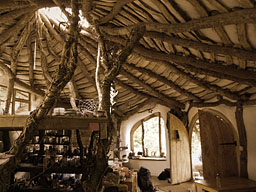
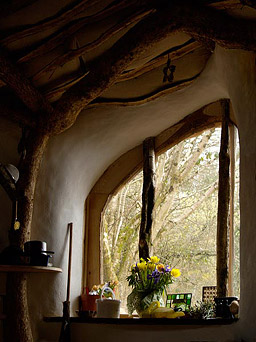
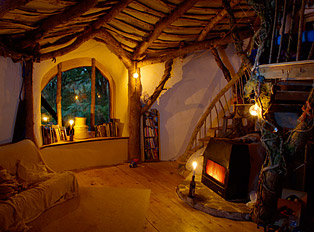
Low Impact Woodland Home


You are looking at pictures of a house I built for our family in Wales. It was built by myself and my father in law with help from passers by and visiting friends. 4 months after starting we were moved in and cosy. I estimate 1000-1500 man hours and £3000 put in to this point. Not really so much in house buying terms (roughly £60/sq m excluding labour).

The house was built with maximum regard for the environment and by reciprocation gives us a unique opportunity to live close to nature. Being your own (have a go) architect is a lot of fun and allows you to create and enjoy something which is part of yourself and the land rather than, at worst, a mass produced box designed for maximum profit and convenience of the construction industry. Building from natural materials does away with producers profits and the cocktail of carcinogenic poisons that fill most modern buildings.


Some key points of the design and construction:

  • Dug into hillside for low visual impact and shelter
  • Stone and mud from diggings used for retaining walls, foundations etc.
  • Frame of oak thinnings (spare wood) from surrounding woodland
  • Reciprocal roof rafters are structurally and aesthaetically fantastic and very easy to do
  • Straw bales in floor, walls and roof for super-insulation and easy building
  • Plastic sheet and mud/turf roof for low impact and ease
  • Lime plaster on walls is breathable and low energy to manufacture (compared to cement)
  • Reclaimed (scrap) wood for floors and fittings
  • Anything you could possibly want is in a rubbish pile somewhere (windows, burner, plumbing, wiring...)
  • Woodburner for heating - renewable and locally plentiful
  • Flue goes through big stone/plaster lump to retain and slowly release heat
  • Fridge is cooled by air coming underground through foundations
  • Skylight in roof lets in natural feeling light
  • Solar panels for lighting, music and computing
  • Water by gravity from nearby spring
  • Compost toilet
  • Roof water collects in pond for garden etc.

Main tools used: chainsaw, hammer and 1 inch chisel, little else really. Oh and by the way I am not a builder or carpenter, my experience is only having a go at one similar house 2yrs before and a bit of mucking around inbetween. This kind of building is accessible to anyone. My main relevant skills were being able bodied, having self belief and perseverence and a mate or two to give a lift now and again.

This building is one part of a low-impact or permaculture approach to life. This sort of life is about living in harmony with both the natural world and ourselves, doing things simply and using appropriate levels of technology. These sort of low cost, natural buildings have a place not only in their own sustainability, but also in their potential to provide affordable housing which allows people access to land and the opportunity to lead more simple, sustainable lives. For example this house was made to house our family whilst we worked in the woodland surrounding the house doing ecological woodland management and setting up a forest garden, things that would have been impossible had we had to pay a regular rent or mortgage. To read more about why we did it and why this is an important option to meet the challenges of climate change and peak oil, click here.

Would you like to learn more about this sort of building and gain practical experience? Why not join us on another exciting building project. There will be opportunities for everyone of all abilities and areas of interest. Click here for more details.

Friday, 14 January 2011

Agenda 21 for Dummies


Agenda 21 explained very well. Including implications it will have on humanity. Opinions within the video come in some cases from those that were in on the negotiations. Truly an interesting watch.

From Pole Shift to HAARP


Following the unexplained deaths of several thousand birds over the last two weeks, events are now emerging that may offer a physics-based explanation for the mysterious deaths. It all begins on a runway in Tampa, where airport officials recently closed that runway in order to change the numeric designators painted there. Why are those numeric designators being changed? Because the Earth's magnetic poles are shifting and the numbers previously painted on the runway no longer match up with the magnetic measurements of sensitive airplane instruments (http://www.physorg.com/news/2011-01...).

As Physorg.com explains:

The primary runway at the airport is designated 18R/36L, which means the runway is aligned along 180 degrees from north (that is, due south) when approached from the north and 360 degrees from north when approached from the south. Now the Federal Aviation Administration (FAA) has requested the designation be changed to 19R/1L to account for the movement of the magnetic north pole.

This brings us to our first physics fact of this article:

Physics Fact #1: The Earth's magnetic poles are shifting. (And not just a little bit, but enough to affect airport runways on the scale of human observation.)

The role of Earth's magnetic field

The Earth's magnetic field is extremely important for protecting the planet from so-called "solar wind" and other electromagnetic influences from space. The magnetosphere, which is driven by the Earth's magnetic field, serves as a kind of electromagnetic barrier to prevent dangerous rays from reaching the surface of the planet.

You can see a picture of that here: http://www.theozonehole.com/magneti...

Physics Fact #2: The Earth's magnetic field has flipped hundreds of times in the past.

The Earth's magnetic field "flips" (or reverses polarity) every few thousand years. This is called a geomagnetic reversal (http://en.wikipedia.org/wiki/Geomag...). In between these flips, the magnetic field can become quite weak and chaotic, causing "turbulence" in the field, which can effectively cause weaker gaps in the magnetosphere.

These magnetic gaps or weaknesses can allow outside influences that normally would not penetrate the magnetosphere to reach deep into that magnetosphere, theoretically all the way down to where birds fly at very low altitude.

Thursday, 13 January 2011

Bird/Fish Massacre Timeline


The recent mysterious deaths of birds and fish are causing alarm among naturalists around the world. Birds are literally falling dead out of the sky, and fish are washing up dead on shores and rivers across North America and around the world. The reaction from the mainstream media seems strangely subdued, as if they're all just blowing this off as some unexplained quirk about the natural world that should be largely ignored.

NaturalNews readers think differently. We are concerned when thousands of dead birds fall out of the sky for no apparent reason. The sky itself may not be falling, but previously live animals are clearly falling out of it. If that's not enough reason to wonder what the heck is happening to our planet, then what is?
These are clear signs that something is wrong. Red flags from nature, if you will. Here's the timeline of recent deaths that have been reported:

12.13.10 - Thousands of dead barramundi fish wash up in Australia, unknown causes (http://www.themorningbulletin.com.a...)

12.15.10 - Thousands of dead fish wash ashore on Florida beach, blamed on cold weather (http://www.cfnews13.com/article/new...)

12.17.10 - Dead fish wash ashore at lake beach in Indiana, blamed on winter storms (http://www.wndu.com/localnews/headl...)

12.18.10 - Thousands of dead fish turn up in bay in Philippines, unknown causes (http://globalnation.inquirer.net/ce...)

12.22.10 - More than a hundred dead pelicans turn up in North Carolina, unknown causes (http://www.carteretnewstimes.com/ar...)

12.23.10 - Hundreds of dead sea creatures wash ashore in South Carolina, blamed on cold water (http://www.abcnews4.com/Global/stor...)

12.23.10 - Ten tons of mostly dead fish found in fishing net in New Zealand, unknown causes (http://www.stuff.co.nz/auckland/loc...)

12.27.10 - Scores of dead fish wash ashore in a lake in Haiti, unknown causes (http://www.france24.com/en/20101227...)

12.28.10 - 70 bats found dead in Tucson, Ariz., unknown causes (http://www.azcentral.com/news/artic...)

12.29.10 - Dozens of fish found dead in San Antonio, Texas, unknown causes (http://www.ksat.com/news/26316464/d...)

12.31.10 - 5,000+ birds found dead in Arkansas, suffering from massive trauma and blood clots (http://www.cnn.com/2011/US/01/03/ar...)

01.03.11 - 100,000+ dead drum fish found in Arkansas river, unknown causes (http://www.todaysthv.com/news/local...)

01.03.11 - Dozens of dead birds show up in a woman's backyard in Kentucky, unknown causes (http://www.wpsdlocal6.com/news/loca...)

01.03.11 - Tens of thousands of dead fish wash ashore in Chesapeake Bay, Md., blamed on cold water (http://www.wbaltv.com/r/26357581/de...)

01.03.11 - 100 tons of dead fish wash ashore in Brazil, unknown causes (http://www.care2.com/greenliving/10...)

01.04.11 - Several dead manatees found on Florida coast, unknown causes (http://www.orlandosentinel.com/news...)

01.04.11 - Thousands of dead fish wash up on creek in Florida, unknown causes (http://www.wftv.com/news/26367953/d...)

01.04.11 - Hundreds of dead fish was ashore on St. Clair River in Ontario, Can., unknown causes (http://www.torontosun.com/news/cana...)

01.04.11 - Hundreds of dead black birds found on highway in Louisiana, suffering from internal injuries and blood clots (http://www.2theadvocate.com/news/11...)

01.05.11 - Hundreds of dead birds found on highway in Texas, unknown causes (http://www.ktre.com/global/story.as...)

01.05.11 - Large amount of dead fish wash up on New Zealand beaches, unknown causes (http://www.nzherald.co.nz/nz/news/a...)

01.05.11 - Up to 100 jackdaw birds found dead on road in Sweden, unknown causes (http://www.thelocal.se/31262/20110105/)

01.06.11 - 40,000+ dead Devil crabs washed ashore in the U.K., unknown causes (http://www.cbsnews.com/8301-503543_...)

01.07.11 - More than 1,000 dead turtle doves found in Italy, unknown causes (http://www.telegraph.co.uk/news/wor...)

01.10.11 - Countless fish found dead in U.K. brook, unknown causes (http://www.peterboroughtoday.co.uk/...)

01.11.11 - Thousands of gizzard shad fish float to the top of Lake Michigan and wash up on the shores near Chicago, blamed on cold weather (http://www.hispanicallyspeakingnews...)

NaturalNews will continue to cover this story in the days ahead. Watch NaturalNews.com for more breaking news on this topic.


Wednesday, 12 January 2011

From Conspiracy to Fact


8 Conspiracy Theories About Health That The Mainstream Media Has Been Forced To Admit Are Actually True

Who knows more about health - the mainstream media or those that believe in "conspiracy theories"? Well, the truth is that time after time after time those in the "alternative media" and those who believe in "conspiracy theories" have been proven to be far ahead of those in the mainstream media when it comes to matters of health. Sadly, the mainstream media receives so much funding and so many advertising dollars from the pharmaceutical industry, the medical industry, the big chemical companies and the health insurance industry that they are extremely cautious to report any information that would be harmful to any of them. So for years, the mainstream media generally refused to talk about the dangers posed by things such as fluoride, aspartame, prescription drugs, genetically modified crops and cell phones. But now the alternative media has been making so much noise about many of these health issues for so long that the mainstream media has been forced to acknowledge that some of these "conspiracy theories" about health are actually true.

Not that the mainstream media is all of a sudden turning their backs on the financial giants that are pumping billions of dollars into them. But the truth is that we are starting to see just a little bit more honest reporting about health issues from the mainstream media these days.

The following are 8 conspiracy theories about health that the mainstream media has been forced to admit are actually true....

#1 High Levels Of Fluoride In Our Drinking Water Is Bad
#2 Once We Allowed Genetically Modified Crops To Be Used They Would Spread Everywhere
#3 There Are Pharmaceutical Drugs And Cancer Causing Chemicals In Our Drinking Water
#4 Cell Phones Are Linked To Cancer
#5 Bisphenol -A (BPA) Is Linked To Male Infertility
#6 Prescription Drugs Kill Large Numbers Of People Every Single Year
#7 Aspartame Is Not Good For Our Health
#8 Many Among The Global Elite (Such As Ted Turner) Want To Institute A Global One-Child Policy And Want To Reduce The World Population For The Good Of The Environment

...FULL FACTS HERE...

Tuesday, 11 January 2011

Hemp's Notorious Cousin


written by Oliver Cowley, animated by Drew Toonz, produced by Patrick Furlotti for the Global Mana Foundation. Globalmana.org

Sunday, 9 January 2011

Reasons to Get Digging


Gardening is an integral part of simple living and a growing number of people are getting down in the dirt. According to a National Gardening Association survey, food gardening was the only category of lawn and garden activity that saw a significant increase in household participation and spending in 2009. Food gardening participation increased by 14% while the total spent increased by 21% over 2008 levels. The Association defines food gardening as including vegetable gardening, fruit trees, growing berries, and herb gardening.

But if you’ve never really grown anything edible, you may be wondering why, exactly, so many people think gardening is so important.

Let’s see…

1. Gardening can save money. As long as you avoid the mindless, consumerist gardening gizmos and contraptions that fill the pages of gardening catalogs ($400 rainbarrels? Are you kidding me?), growing your own vegetables will save you money. Keep it simple sweetie, aim to use the energies and resources that are flowing through your property for free and you will come out ahead.

2. Gardening beats inflation. Even if you buy seedlings and seeds every year, growing some percentage of your own food will beat the inflationary spiral of food prices that’s sure to hit as peak oil begins to be felt. (Our entire industrial food system is based on oil; supplies are leveling out and will soon begin to decline.)

3. Gardening gets you back in touch with nature. When you’re outside, digging in the dirt or transplanting your seedlings, you become much more aware of the life that surrounds you. Birds sing, bees buzz, earthworms work the earth. Turns out humans aren’t the center of the universe after all.

...MORE HERE...

Thursday, 6 January 2011

Bird/Fish Massacre Goes Global - Latest Theories


Nicholas West and Zen Gardner
Activist Post

As the mainstream media attempts to downplay the latest die-off event, which has now gone global, it is worthwhile to keep track of the story lines. Feel free to add your own to the comments section, and we will update accordingly.

Mainstream Explanations: Lightning, hail, mid-air collision, power lines, and New Year fireworks for the birds . . . but disease for the fish. This is even rolling eyes in the mainstream media. Birds are incredibly sensitive to their environment (think canary in the coal mine), and the thought that they were caught by surprise, or that they "fowled" up their flight pattern is patently ridiculous. And where are the roasted birds from this lightning strike? And what about fish dying in the same region? Just a "disease" coincidence. One mainstream headline has to be enshrined as the saddest attempt at sensationalism, while revealing an obvious natural conclusion Falling Birds Likely Died From Massive Trauma. Really?

Geoengineering:
Could spraying in the area have caused this type of fallout? Perhaps something new added to the mixture? Chemtrails have quickly moved from conspiracy theory to documented fact. So much so, that the powers-that-be have had to admit to the program, but a beneficial one in their view. Between cloud seeding and possible connections to HAARP, chemtrail fallout must be considered, especially as it is being conducted nearly worldwide. Rosalind Peterson has been at the forefront of connecting geoengineering to GMOs as a combined source for oxygen-depleting algae blooms that very well could affect a wide spectrum of natural systems. Furthermore, some believe that the delivery system for chemtrails can also disperse pathogens. If there is a flu or disease outbreak in the coming days or weeks among the human population in areas where the birds have fallen, the chemtrail connection could be made. If this happens, the contagion could be blamed on a new, deadly bird flu. A last possibility connected to chemtrails would be nanoparticles.

HAARP: Birds and fish can be susceptible to subtle frequency alteration. An interesting YouTube post from a long-time fisherman mentioned the "pearl" plate behind the eye of the affected type of drum fish in this event. He made a plea for anyone in the area to look for signs of damage to this plate. Both birds and fish navigate in highly coordinated ways that indicate that they move and communicate via frequencies. Could the HAARP array in Alaska have short-circuited their navigation systems? Or, perhaps this is the beginning of a cascading effect from decades of electromagnetic pollution emanating from EMF and ELF waves shot around the planet via a wide range of modern communications

...MORE HERE...

Wednesday, 5 January 2011

Health Ranger's predictions for 2011 - 2012


What's ahead for 2011 - 2012? This time in human history promises to bring forth more changes than any other similar duration of time known to our civilization. I believe the changes that will occur in the next two years will rock the foundations of our economies, governments and belief systems. In the end, after considerable turmoil, I see a great expansion of human consciousness and a maturing of the human race. Here are the details...

More people growing their own food

Beginning in 2011 and continuing for many years beyond, we will see an explosion in the number of people growing their own food. People see the big trends in the food supply fast approaching: GMO contamination of crops, the loss of local food production due to FDA interference, the crackdown on small farmers, and even disruptions in the global food supply.

Increased awareness of natural remedies and health freedom

The natural health community will achieve significant victories over the next two years in awakening people to natural remedies, medicinal herbs and the core ideas of health freedom. The monopolistic pushers of pharmaceuticals are fighting a desperate, losing battle to try to keep people ignorant, but they will lose that fight and natural medicine will ultimately emerge as the healing method of choice for an increasing number of people

More people waking up to reality

Today, most people are sleepwalking through their lives, functioning as cogs in a giant machine of which they have no knowledge and no control. Over the next two years, that will significantly change. More and more people will be awakened into a state of awareness. They will realize that living out their lives working mundane jobs, watching television, eating junk food and taking pharmaceuticals is not fulfilling their true purpose in life, and many will seek a higher purpose.

Long-term predictions

• Over the next decade, I predict a disappearing "health middle class" and a great divide between the healthy and the sick. The healthy, you see, are consuming superfoods, getting sunshine on their skin and taking nutritional supplements on a daily basis. The unhealthy are eating processed foods, taking prescription medications and following the advice of their ignorant doctors even if it kills them. There will be fewer people of "average" health in America in the coming years. The masses will gravitate toward disease and sickness while the informed few (such as NaturalNews readers, raw food vegans, superfood fans and so on) will get healthier and more productive.

: MORE HERE

Monday, 20 December 2010

How Permaculture Can Save Humanity and the Earth, but Not Civilization

By Toby Hemenway
Author of Gaia’s Garden: A Guide to Home-Scale Permaculture (2d Ed.)

The revised and updated edition also features a new chapter on urban permaculture, designed especially for people in cities and suburbs who have very limited growing space. Whatever size yard or garden you have to work with, you can apply basic permaculture principles to make it more diverse, more natural, more productive, and more beautiful. Best of all, once it’s established, an ecological garden will reduce or eliminate most of the backbreaking work that’s needed to maintain the typical lawn and garden.


.
nicholasschoolatduke | 22 September 2010 | likes, 2 dislikes

Hemenway is a frequent teacher, consultant and lecturer on permaculture and ecological design throughout the U.S. and other countries. His writing has appeared in magazines such as Natural Home, Whole Earth Review and American Gardener. He is an adjunct professor in the School of Graduate Education at Portland State University, a Scholar-in-Residence at Pacific University, and a biologist consultant for the Biomimicry Guild.

...MORE HERE...

Sunday, 19 December 2010

PS - Paul Stamets, Fungi


Stamets is on the editorial board of The International Journal of Medicinal Mushrooms, and is an advisor to the Program for Integrative Medicine at the University of Arizona Medical School, Tucson, Arizona. He is active in researching the medicinal properties of mushrooms,[2] and is involved in two NIH-funded clinical studies on cancer and HIV treatments using mushrooms as adjunct therapies. Having filed numerous patents on the antiviral, pesticidal, and remediative properties of mushroom mycelia, his work has been called pioneering and visionary.[3] A strong advocate of preserving biodiversity, Stamets supports research into the role of mushrooms for ecological restoration.

The author of numerous books and papers on the subject of mushroom identification and cultivation, Stamets has discovered four new species of mushrooms. He is an advocate of the permaculture system of growing, and considers fungiculture a valuable but underutilized aspect of permaculture. He is also a leading researcher into the use of mushrooms in bioremediation, processes he terms mycoremediation and mycofiltration.

Stamets was the recipient of the "Bioneers Award" from The Collective Heritage Institute in 1998,[4] as well as the "Founder of a New Northwest Award" from the Pacific Rim Association of Resource Conservation and Development Councils in 1999. He was also named one of Utne Reader's "50 Visionaries Who Are Changing Your World" in their November–December 2008 issue. In February 2010, Paul received the President's Award from the Society for Ecological Restoration: Northwest Chapter, in recognition of his contributions to Ecological Restoration. His work was featured in the documentary film The 11th Hour.[5]

In 2008, he delivered a TED talk: "Paul Stamets on 6 Ways Mushrooms Can Save the World". [1]

...MORE FUNGI...

Tuesday, 14 December 2010

Leaked Memo on Bee Massacre Points to Bayer


A new leaked memo from the EPA has the beekeeping world buzzing. Bad puns aside, the failure of the EPA to protect the environment -- in this case, bees -- jeopardizes beekeepers' ability to continue in their work. Beekeeper Tom Theobald, who exposed the leaked memo, says that beekeepers now lose 30 to 40 percent or more of their hives each year, and it takes two years to recover each one. Theobald has been a beekeeper in Boulder County, Colorado for 35 years, but now he says he's not sure he can continue. "I can't afford to subsidize this as a hobby. I'll fold the tent," he says. "Commercial beekeepers will work themselves to death," he continues, noting that it's only the passion and commitment of beekeepers that has staved off a complete collapse of the entire beekeeping industry this long.

The leaked EPA memo, dated November 2, 2010, focuses on Bayer CropScience's request to register (i.e. legalize) its pesticide clothianidin for use on mustard seed and cotton. Clothianidin was first registered in May 2003, but its registration was conditional on safety testing that the EPA said should be completed by December 2004. Only, as the latest memo points out, the study, when it was done (long after 2004), was inadequate in demonstrating that clothianidin does not pose a threat to honeybees. Unfortunately, with the EPA's failure to ensure clothianidin's safety before allowing its use on corn and canola, it fell to beekeepers to discover why their bees were dying, and how the EPA allowed clothianidin on the market.

...MORE HERE...

...MORE on BAYER...


...octomedia

http://www.whale.to/vaccines.html


[Video] Bayer Sells AIDS-Infected Drug Banned in U.S. in Europe, Asia - Unearthed documents show that the drug company Bayer sold millions of dollars worth of an injectable blood-clotting medicine -- Factor VIII concentrate, intended for hemophiliacs -- to Asian, Latin American, and some European countries in the mid-1980s, although they knew that it was tainted with AIDS. Bayer knew about the fact that the drug was tainted and told the FDA to keep things under wraps while they made a profit off of a drug that infected its patients. If these allegations are true, then both Bayer and the FDA are at fault for this catastrophe. FDA regulators helped to keep the continued sales hidden, asking the company that the problem be ''quietly solved without alerting the Congress, the medical community and the public,'' according to the minutes of a 1985 meeting

octomedia

Vaccine Information and Awareness sites:

http://thinktwice.com/

http://www.vaclib.org/

Friday, 10 December 2010

Cancun Climate Cabal - Plan B

The UN Climate talks in Cancun are now focusing on geoengineering, using it as a tool to extort a binding UN treaty to reduce phony global warming. The AP reported today that "we may need geoengineering as a 'Plan B,' if nations fail to forge agreement on a binding treaty to rein in greenhouse gases", per a British House of Commons report.

Geoengineering and contrived global warming lies are facets of Agenda 21, the overarching blueprint for control and depopulation. The article states that geoengineering can cause rain precipitation and other weather changes.

The AP article revealed that the primary forces behind geoengineering are the UN, the US and the UK. The US and the UK governments urged the UN Intergovernmental Panel on Climate Change (IPCC) to study geoengineering, with the US in the research forefront. The article says that "specialists regard the stratospheric sulfates proposal as among the most feasible"- this means chemtrails. But instead of sulfates, patents and evidence indicate that aluminum and barium are currently being sprayed. The US National Oceanic and Atmospheric Administration (NOAA) will do the unreliable computer modeling tests for the US research. Watch this video to understand that this is a depopulation program and this NOAA scientist advocates "doing whatever we can to reduce population".

The new willingness of the UN to consider geoengineering comes just weeks after the UN's Biodiversity conference in Japan wherein they imposed a moratorium on it until the implications could be fully studied. The UN used the 'moratorium' for support to gain global control over geoengineering and weather. Notably, the US did not sign the UN Biodiversity Convention (another word for 'treaty') in favor of the moratorium and UN control.

The UK government hosts the Hadley Center at East Anglia University, the home-base of the UN IPCC and is known for the 'Climategate' scandal and manipulated science. Margaret Thatcher established Hadley Center to usher in globalism and to weaken US power. The UN IPCC will pay off hundreds of scientists to study geoengineering for the IPCC's next assessment report. The UK supports UN control over geoengineering.

...MORE HERE...

Sunday, 28 November 2010

Cleaning Without Chemicals: Recipes for a Toxic-Free Home

The following is an excerpt from Your Green Abode: A Practical Guide to a Sustainable Home by Tara Rae Miner (Skipstone, 2010).

It used to be that we kept our homes clean by using whatever was at hand. A little baking soda from the cupboard mixed with elbow grease took out caked-on crud. Soap was soap, and it served more than one purpose, whether that was to clean your hands or the dishes. Sugar ants were best prevented by putting the sugar away.

But then things were made easier for us. A swift spray of a sickly sweet-smelling substance would kill those ants in a flash. A thick squirt of whitish goo gave the table a lustrous shine in just minutes. Grainy antiseptic scouring powder cut through the scum in the tub with little effort. Thank goodness for chemicals. At least that's what folks were told and sold and eventually wholeheartedly believed.

The rapid growth of the chemical industry after World War II changed housekeeping forever and not necessarily for the better. Chemists whose previous employment was manufacturing weapons realized that similar concoctions could be used to fight agricultural pests and improve consumer products.

Since the fifties, some 75,000 chemicals have been introduced into our world. Three hundred of those can now be found within our bodies, even in the bodies of newborn babies who inherit synthetic chemicals from their mothers. All those cleaning products and pesticides in the cupboard are more than evidence of a wellkept home. They are a toxic testimony of the chemicals that we willingly bring into our lives in the name of cleanliness.

...MORE HERE...

Friday, 26 November 2010

28 Must-Read Books That Will Forever Change How You See the World

This post first appeared on EcoSalon

1. Cradle to Cradle: Remaking the Way We Make Things by William McDonough & Michael Braungart. Why settle for a throwaway culture? This book is a must read because it inspires elegant design solutions, stating that every single product must either go back to the earth or back into industry to be made into something else. A revolutionary way of upgrading the Industrial Revolution – talk about life changing.

2. Introduction to Permaculture by Bill Mollison. The classic text on permaculture design (which is not limited to gardens, but can also be used to design homes, communities and societies in general). An excellent introduction for the aspiring student or someone who just wants to know what it’s all about.

3. The World Without Us by Alan Weisman. What exactly would happen to the earth if human life disappeared? The author explores a few different scenarios in great detail (including a suddenly depopulated Manhattan). Absolutely addictive reading.

4. Animal, Vegetable, Miracle: A Year of Food Life by Barbara Kingsolver. A great read for the locavores. The author spends a year eating only from her garden, or that which is locally grown or raised. A foodie’s delight, this book proves how richly one can live off the land.

5. Eating For Beauty by David Wolfe. Leading raw foodist David Wolfe takes that old adage “you are what you eat” to a new level. He describes how what you eat literally creates who you are, and which foods will create the most beautiful you – in body and in spirit.

6. Lifeplace: Bioregional Thought and Practice by Robert L. Thayer, Jr. In a world gone insanely global, this book takes us deeper into the microcosm. A bioregion is defined by nature, not by politics, and having intimate connection with your home means living within that context – historically, geographically and culturally.

7. Green Building & Remodeling For Dummies by Eric Corey Freed. Written by the founder of organicARCHITECT, this book is a comprehensive guide to green building materials and techniques, energy and water systems, and the pros and cons of everything. Check out a sample chapter here.

8. Gaia: A New Look at Life on Earth by James Lovelock. First published in 1979, this book sets forth the Gaia Hypothesis, stating that our planet is more than a sum of its resources, but rather a fully integrated living being, with systems of life more complex than previously imagined. I wonder what Gaia’s thinking about us now?

9. The Omnivore’s Dilemma: A Natural History of Four Meals by Michael Pollan. Follow a McDonald’s meal back to a cornfield in Iowa. Learn about the differences between large and small organic farms. See what it’s like to hunt and gather for oneself. Food is what builds our bodies – we ought to know what it takes to build our food.

10. Ecovillages: A Practical Guide to Sustainable Communities by Jan Martin Bang. Documenting some of the successful Ecovillages around the world, the author shows us how groups of people have come to together to live out the permaculture model in both rural and urban environments.

...MORE HERE...

Wednesday, 3 November 2010

the Car That Runs on Thin Air


...Free Energy from compressed air with the Air-Pod, Why not?...

Sunday, 31 October 2010

PenZance Skies - a Swansong for the Sun


revatjazz | 29 October 2010

...take a ride through the skies of Penzance from Zingy Round to St Michael's Mount. Under the Clouds and into the sunset, it's a Swansong for the Sun...
...music - Paul Lewin and Friends...
...photos - Mungo Shoddy...
...anotherVHFtransmission...

Food in Uncertain Times

In an age of erratic weather and instability, it's increasingly important to develop a greater self-reliance when it comes to food. And because of this, more than ever before, farmers are developing new gardening techniques that help achieve a greater resilience. Longtime gardener and scientist Carol Deppe, in her new book The Resilient Gardener: Food Production and Self-Reliance in Uncertain Times, offers a wealth of unique and expansive information for serious home gardeners and farmers who are seeking optimistic advice. Do you want to know more about the five crops you need to survive through the next thousand years? What about tips for drying summer squash, for your winter soups? Ever thought of keeping ducks on your land? Read on.

Makenna Goodman: Many gardeners (both beginners and more serious growers) come across obstacles they might not have planned for. In your new book, The Resilient Gardener: Food Production and Self-Reliance in Uncertain Times, you talk about the need for real gardening techniques for both good times and bad. What is the first step toward achieving this kind of resilience?

Carol Deppe: The basic issues are getting more control over our food, getting lots higher quality and more delicious food, and enhancing the resilience of our food supply. There are three ways to do that. The first is through local buying patterns and trade. A second is through knowing how to store or process food that is available locally, whether we grow it ourselves or not. The third is gardening. In The Resilient Gardener, I talk as much about storing and using food as growing it. I love gardening, but not everyone is in a position to garden every year of their lives.

However the person who has learned to make spectacular applesauce or cider or apple butter or pies can often trade some of the processed products for all the apples needed. Buying local food supports local food resilience. A couple hundred pounds of gourmet-quality potatoes tucked away in the garage -- potatoes that you have learned to store optimally -- represent serious food security, whether you grew them or bought them from a local farmer right after the harvest. Our buying and trading patterns and our skill at storing and using food as well as gardening are all part of our food resilience. All can serve as the starting point to begin taking greater control over our food.

So the first thing I would say is, garden if you can and if you enjoy it. Whether you garden right now or not, though, learn more about how to store and use the food that is grown locally.

...MORE HERE...